
The Landsmannschaft Saxo-Suevia dates its foundation to 10 February 1878. The history of our fraternity, which today has around 170 members, goes back to different roots in five university towns: Berlin, Leipzig, Breslau, Jena and Erlangen. In 2028 we will celebrate our 150th foundation festival.
- 1878Foundation of the Landsmannschaft Suevia in Jena on 10 February
- 1885Foundation of the Turnerschaft Suevia in Breslau
- 1911Saxo-Hansea Leipzig and Guestphalia Berlin merge into the Landsmannschaft Saxo-Guestphalia Erlangen
- 1936Student fraternities dissolved by the National Socialists
- 1949Saxo-Guestphalia reopens in Erlangen
- 1957Inauguration of the fraternity house in the Löhestraße
- 1969Merger into the Landsmannschaft Saxo-Suevia zu Erlangen on 22 February
- 1971Completion of the student residence at Löhestraße 19a
- 1976/77Presiding fraternity of the Coburger Convent: “Family of European Nations – A Goal Without Alternative”
- 2022/23Presiding fraternity again: “Family of European Nations – One Destiny, One Future”
- 2028150th foundation festival
1878 to 1933
Today's Landsmannschaft first appeared in Erlangen in 1911. In that year the Turnerschaft Saxo-Hansea Leipzig and the Landsmannschaft Guestphalia Berlin merged into the Landsmannschaft Saxo-Guestphalia Erlangen. Its first home was one floor on today's Martin-Luther-Platz 6. Only after the First World War, in 1921, could it buy a house of its own at Bergstraße 13.
In parallel and completely independently of Saxo-Guestphalia, the Landsmannschaft Suevia Jena was founded on 10 February 1878 in tranquil Thuringia. Suevia played an important part in the formation and struggles of the Landsmannschaft umbrella associations. In 1901 it acquired the inn “Schöne Aussicht” as its fraternity house and made a good name for itself in fencing. More than 100 members took part in the First World War; 12 of them fell on the fronts in the east and west.
The third branch of today's Landsmannschaft developed in Breslau, then part of Prussia, with the foundation of the Turnerschaft Suevia Breslau in 1885. Suevia became one of the leading fraternities in Breslau and chaired important student bodies several times as early as the days of the Empire. Almost all of its members took part in the First World War; twenty died in the field. In the Weimar Republic they took up old traditions again. Suevia (co-)founded various organisations, among them the Breslau university ring. Its own house at Parkstraße 27 was inaugurated in 1932.
1933 to 1945
In 1933, the year the National Socialists seized power, three branches of today's Saxo-Suevia were active: the Landsmannschaft Saxo-Guestphalia Erlangen, the Landsmannschaft Suevia Jena and the Turnerschaft Suevia Breslau.
Regardless of the university town, the Nazi seizure of power meant a break with the traditional structure of universities and student life. For the student fraternities it was the final end of their dominance in university politics, which had already been dented in the Weimar Republic. The National Socialist German Students' League (NSDStB) never intended to leave the fraternities their traditional place at the university, even if this was not clearly apparent at first. The new student law introduced in May 1935 established the long-demanded right of co-determination of the “Deutsche Studentenschaft” (DSt) and provided for a representative of the fraternities within the DSt. For the first time in history, it also explicitly allowed the Mensur by law for the fencing fraternities.
Not least for these reasons, the institutional interference in the fraternities' structure was overlooked, above all the obligation to introduce the “leader principle” and the compulsory SA service of the young students. In most fraternities, including our three founding fraternities, the leader principle remained a paper tiger; the democratic principle of the Convent was retained.
Institutionally, none of the three fraternities can be classified as either for or against National Socialism, although a right-wing conservative attitude prevailed in all three. Among individual members, however, even within each fraternity, there were great differences, which also led to disputes and resignations. This is reflected in the biographies of individual members: from the “silent democrat” to the “convinced National Socialist”, every attitude was represented. We also carry the heavy burden of having to call a mass murderer a former “Bundesbruder”.
From 1933 the NSDStB ruled the universities through its positions in the DSt. It had already abandoned its aggressive stance against the fraternities at the end of the 1920s, but with the seizure of power it began to strip them of their power step by step. The student fraternities were officially dissolved by Rudolf Heß on 26 January 1936.
Until then, so-called “residential fellowships” had to be set up in the fraternity houses as a first step, which also happened in Jena, Breslau and Erlangen. The Erlangen Saxo-Guestphalia no longer experienced the setting up of fellowship houses according to NSDStB guidelines: they sold their house in the Bergstraße and joined a fellowship in another Erlangen fraternity house. In Jena and Breslau, such fellowships were allowed in the fraternities' own houses.
Whether there were Jewish members and how they were treated cannot be reconstructed from the records available today.
In the Second World War, 6 members of Saxo-Guestphalia Erlangen, 20 of Suevia Breslau and an unknown number of Suevia Jena were killed. The fraternity house in Breslau was occupied by the Volkssturm; what was left was looted by the neighbours in the last months of the war. In Jena, the beautifully situated house was destroyed by a bomb.
Since 1945
After the Second World War, none of the three fraternities owned a house any more. Most members had been killed or wounded, were refugees or prisoners of war, or were trying to rebuild their lives. Student fraternities were banned in all occupation zones. Breslau was no longer German territory, and reactivation was also out of the question in the Soviet zone of occupation, later the GDR. The Landsmannschaft Suevia Jena and the Turnerschaft Suevia Breslau had thus lost their home.
Suevia Jena gathered in Bonn and was re-established in 1952 as the Landsmannschaft Suevia Jena zu Bonn. The lack of a fraternity house as the centre of life made recruiting new members difficult. When a suitable house was found in the Agnesstraße in Hamburg in 1957, Suevia moved to the Hanseatic city and from then on called itself Landsmannschaft Suevia Jena zu Hamburg.
Suevia Breslau found first accommodation in Frankfurt am Main and cooperated with the local Turnerschaft Alsatia. The relationship broke down at the end of the 1950s, and Suevia decided to revive its own tradition: by merging with Suevia Hamburg, with which it shared not only the name but also the colours light blue, white and black.
The resulting Landsmannschaft Suevia Jena-Breslau zu Hamburg existed from 1957 until the end of the 1960s. A lack of new members led to the suspension of the active group in March 1968 and to merger negotiations with the Landsmannschaft Saxo-Guestphalia Erlangen, which was also struggling to find new members.
Saxo-Guestphalia had already reopened in Erlangen in 1949. In the early years its gatherings took place at the Gasthaus Nützel. In 1957 the fraternity house in the Löhestraße, which is still the centre of our life today, was inaugurated.
With the merger of the Landsmannschaften Saxo-Guestphalia Erlangen and Suevia Jena-Breslau zu Hamburg into the Landsmannschaft Saxo-Suevia zu Erlangen on 22 February 1969, the foundation stone for today's fraternity was laid. The merger also made it possible to build a student residence next to the fraternity house at Löhestraße 19a, which was completed in 1971 in the presence of representatives of the university.
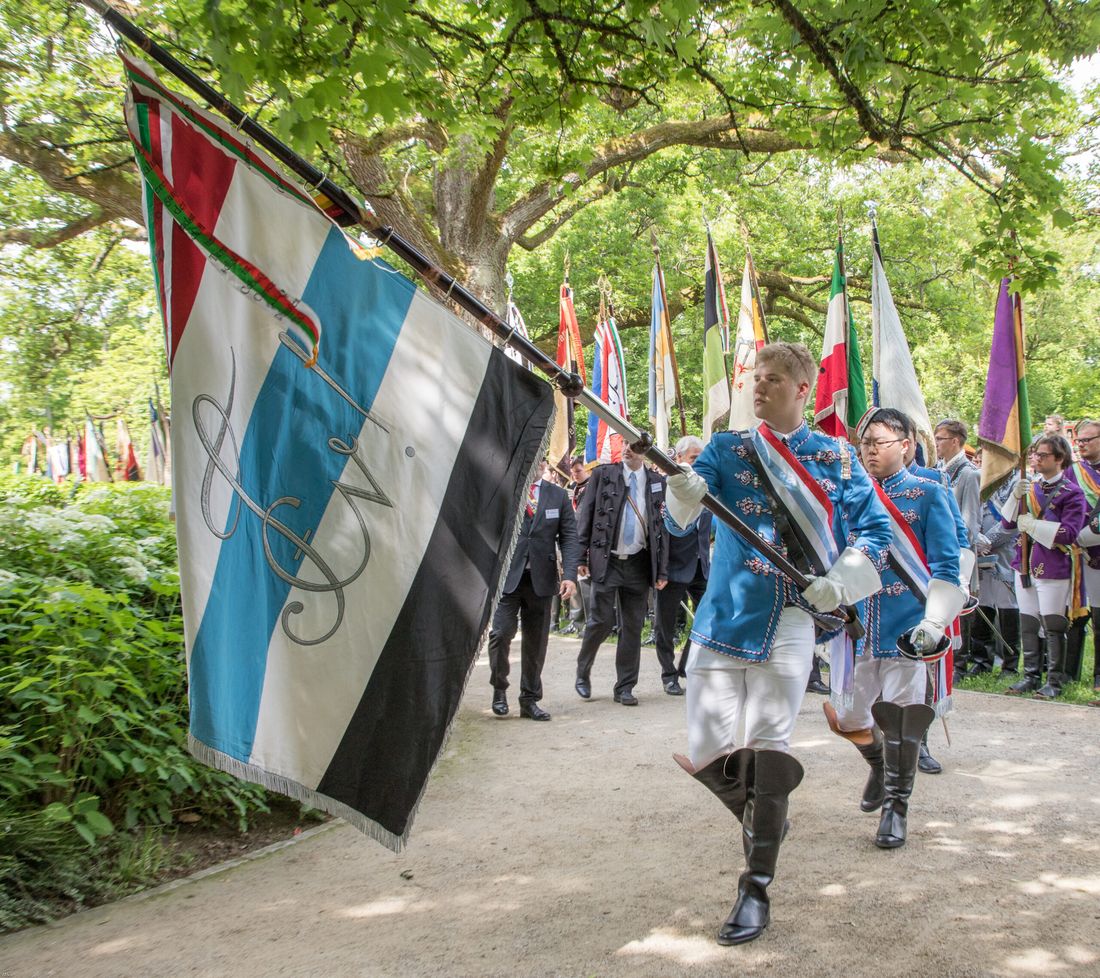
In the presidential year 1976/77, Saxo-Suevia had the great honour of presiding over the Coburger Convent. The year was held under the motto “Family of European Nations – A Goal Without Alternative”. The idea came above all from our fellow member Johannes Steinhoff, a retired general, former Chairman of the NATO Military Committee and a committed European. In 2022/23 we presided again and continued the motto as “Family of European Nations – One Destiny, One Future”.
Later, too, we were repeatedly able to attract prominent speakers to our events. At our 125th foundation festival (2003) and our 130th (2008), the Bavarian Minister of the Interior of the day gave the keynote speech.
Today's Landsmannschaft Saxo-Suevia is still a fencing fraternity and upholds the principle of a lifelong bond. It is a member of the “Coburger Convent der Landsmannschaften und Turnerschaften an deutschen Hochschulen” and of the Silberkartell. We are not bound to any ideology, religion or politics, let alone to any position in scientific questions, and we reject extreme positions. What we stand for today.